
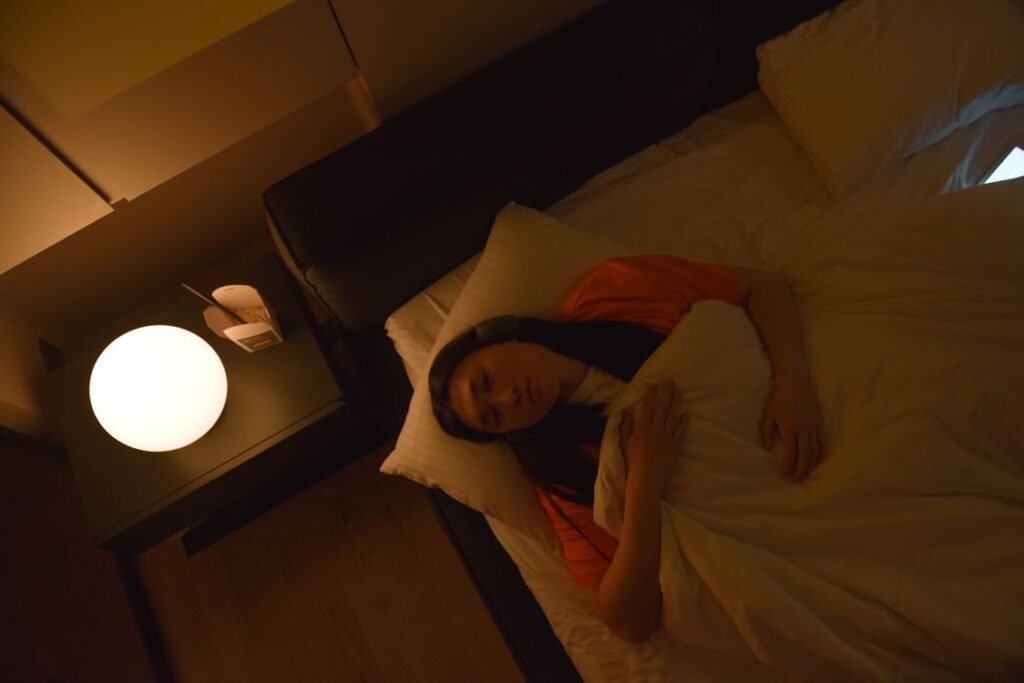
You have been up since 6am. You barely sat down all day. By 9pm your eyes are heavy and your body is screaming for rest. But the moment you get into bed, something shifts. Your mind turns on. Your heart rate picks up slightly. And sleep, which felt so close five minutes ago, seems suddenly unreachable.
Part of our Sleep Guide series
For the complete picture on sleep improvement, read our main guide: How to Sleep Better — The Complete Evidence-Based Guide →
This experience has a name: hyperarousal. It is one of the most common and least understood sleep problems, and it is particularly prevalent in women over 35. Understanding why it happens is the first step toward actually fixing it.
The exhaustion-but-wired paradox explained
Your body and your brain have different definitions of “tired.” Physical exhaustion (tired muscles, heavy limbs, yawning) is managed by your body’s adenosine system — a neurochemical that builds up throughout the day and signals sleepiness. This is working fine when you feel physically drained.
Sleep onset, however, requires something else: a shift in your autonomic nervous system from sympathetic dominance (alert, responsive, cortisol-active) to parasympathetic dominance (calm, restorative, sleep-ready). And this shift can be blocked even when your body is completely depleted.
The three most common blockers in women 35+:
1. Chronically elevated cortisol
Cortisol is your primary stress hormone, and it is designed to keep you alert. In a healthy rhythm, cortisol peaks in the morning and drops through the evening. But chronic stress — the sustained, low-level pressure of modern life — disrupts this rhythm. Evening cortisol stays elevated, directly suppressing melatonin production and keeping your nervous system in a state of readiness even when you are physically exhausted.
For women navigating the physiological changes of perimenopause, this is compounded by declining progesterone — a hormone with natural calming, GABA-supporting effects. Lower progesterone means less neurological buffer against elevated cortisol.
2. Conditioned hyperarousal
Your brain learns. If you have spent many nights lying in bed awake, your brain begins to associate the bedroom and bedtime with wakefulness and frustration — the opposite of the calming association you need. This is called conditioned arousal, and it can persist long after the original stressor that caused it has been resolved.
This is why people find they sleep fine on holiday or in a different environment — the conditioned association does not follow them to an unfamiliar bed.
3. The “monitor brain” problem
Research on insomnia consistently identifies a pattern called “sleep monitoring” — a state of heightened self-awareness about whether you are sleeping. The moment you get into bed, part of your brain starts checking: Am I sleepy enough? Is this working? What time is it? How many hours do I have left? This monitoring activity is cognitively arousing, and it creates a self-defeating loop.
Why “just relax” does not work
Telling someone with hyperarousal to relax is like telling someone who is anxious to “just calm down.” The problem is precisely that the self-regulatory mechanism is not functioning normally. Willpower cannot override a nervous system in alert mode — you need to change the neurological signal, not the intention.
This is why scrolling your phone “to wind down” backfires: it adds visual stimulation and mental engagement at exactly the moment your nervous system needs to be transitioning. And it is why a glass of wine helps you feel sleepy but does not improve the quality of sleep — alcohol suppresses REM sleep and increases night waking in the second half of the night.
What actually works for hyperarousal
Effective interventions for hyperarousal work with the nervous system rather than fighting it. Evidence-backed approaches:
Slow, controlled breathing
Extended exhalation (breathing out for longer than you breathe in) directly activates the parasympathetic nervous system. The 4-7-8 technique — inhale for 4, hold for 7, exhale for 8 — produces measurable reductions in heart rate within minutes. It works regardless of whether you “feel” it is working.
Brainwave entrainment through sound
Frequency therapy using binaural beats is one of several sound-based approaches researchers have studied for nervous system downregulation, though the evidence base here is still smaller and more mixed than for established techniques like CBT-I or breathing exercises. When two slightly different tones are played separately in each ear, your brain perceives and synchronises to the difference between them — a process called brainwave entrainment. Delta and theta frequency programs are intended to guide the brain out of the alert beta state that characterises hyperarousal and into the relaxed, pre-sleep state that enables natural sleep onset.
Platforms like SpryFuel offer extensive libraries of frequency therapy programs designed specifically for sleep onset, stress reduction and nervous system calming. The 7-day free trial is a low-risk way to discover whether this approach works for your nervous system. (Affiliate link — disclosure)
The cognitive offload method
Research from Baylor University found that spending five minutes writing tomorrow’s to-do list before bed reduced time to sleep onset significantly compared to a control group. The mechanism: externalising the mental checklist removes the brain’s need to actively hold those thoughts, reducing monitoring activity.
Consistent sleep timing
Your circadian rhythm is a timing system, not just a preference. Going to bed and waking at the same time each day — including weekends — gradually re-establishes the conditioned association between bedtime and sleep onset. This is the single most evidence-backed intervention for chronic sleep difficulty, and it is completely free.
When to speak to a doctor
Hyperarousal-based sleep difficulty usually responds well to behavioural approaches. But there are patterns that warrant medical evaluation: loud snoring, gasping or stopping breathing during sleep (possible sleep apnoea), persistent exhaustion despite adequate hours in bed, or symptoms that have lasted more than three months without improvement. These may have underlying causes that behavioural interventions alone will not address.
A practical protocol for tonight
Understanding the cause of hyperarousal is useful. Having a concrete plan for tonight is more useful. Here is a five-step protocol to implement immediately, starting with whichever elements feel most accessible:
Step 1 — 20 minutes before bed: the brain dump (5 minutes)
Take a pen and paper — not your phone — and write down every unfinished thought, tomorrow’s tasks and anything you are trying to remember. Put the notebook away. This is not journalling. It is externalising your mental queue so your brain can stop running it.
Step 2 — 15 minutes before bed: environmental shift
Dim all lights significantly. Put your phone on Do Not Disturb, screen down, in another part of the room. Lower the thermostat if possible. These three signals — darkness, silence, cool temperature — are the primary environmental triggers for melatonin release. Most people skip this and wonder why they do not feel sleepy.
Step 3 — 10 minutes before bed: active downregulation
Choose one of the following (not all three — pick the one that appeals):
- 4-7-8 breathing: Inhale 4 counts, hold 7, exhale 8. Repeat four times. Takes 90 seconds. Works immediately on the parasympathetic nervous system.
- Sound therapy: Put in headphones and listen to a binaural beats or frequency therapy programme designed for sleep onset. Platforms like SpryFuel offer specific programmes for this. Passive — requires no concentration.
- Progressive muscle relaxation: Tense each muscle group for five seconds, release. Start at feet, move to face. Takes eight minutes. Produces measurably deeper physical relaxation than passive lying still.
Step 4 — In bed: stop trying to sleep
Paradoxical intention is one of the more counter-intuitive but well-evidenced strategies in sleep research. Instead of trying to fall asleep, give yourself permission to simply lie still with your eyes closed and let whatever happens, happen. The act of trying to sleep creates performance anxiety that raises arousal. Removing the expectation removes the anxiety.
Step 5 — If still awake after 20 minutes: get up
This is the most important rule and the hardest to follow. Get out of bed. Go to another room. Read something unexciting in dim light. Return to bed only when you feel genuinely sleepy. This prevents the bed from becoming a place your brain associates with wakefulness — which is exactly what has happened for many people with chronic sleep difficulty.
Tracking whether it is working
The most reliable way to know if your sleep is improving is to track two things for two weeks: time to fall asleep (estimated) and how you feel within 30 minutes of waking. These two measures, rated simply on a scale of 1–5, give you enough data to know whether the protocol is working before you invest in anything further.
Frequently asked questions
💤 Take action tonight:
The 7-Step Bedtime Routine — a complete system built around calming hyperarousal.
Best Magnesium for Sleep — the supplement most evidence-backed for reducing evening cortisol.
Written by the Easy Healthy Time Editorial Team
Evidence-based health content for women 35+. Learn more →
Affiliate disclosure: This article contains affiliate links. If you purchase through our links, we may earn a small commission at no extra cost to you. We only recommend products we genuinely believe in. Read our full disclosure.